
Introduction: Treat the catalog as an active asset
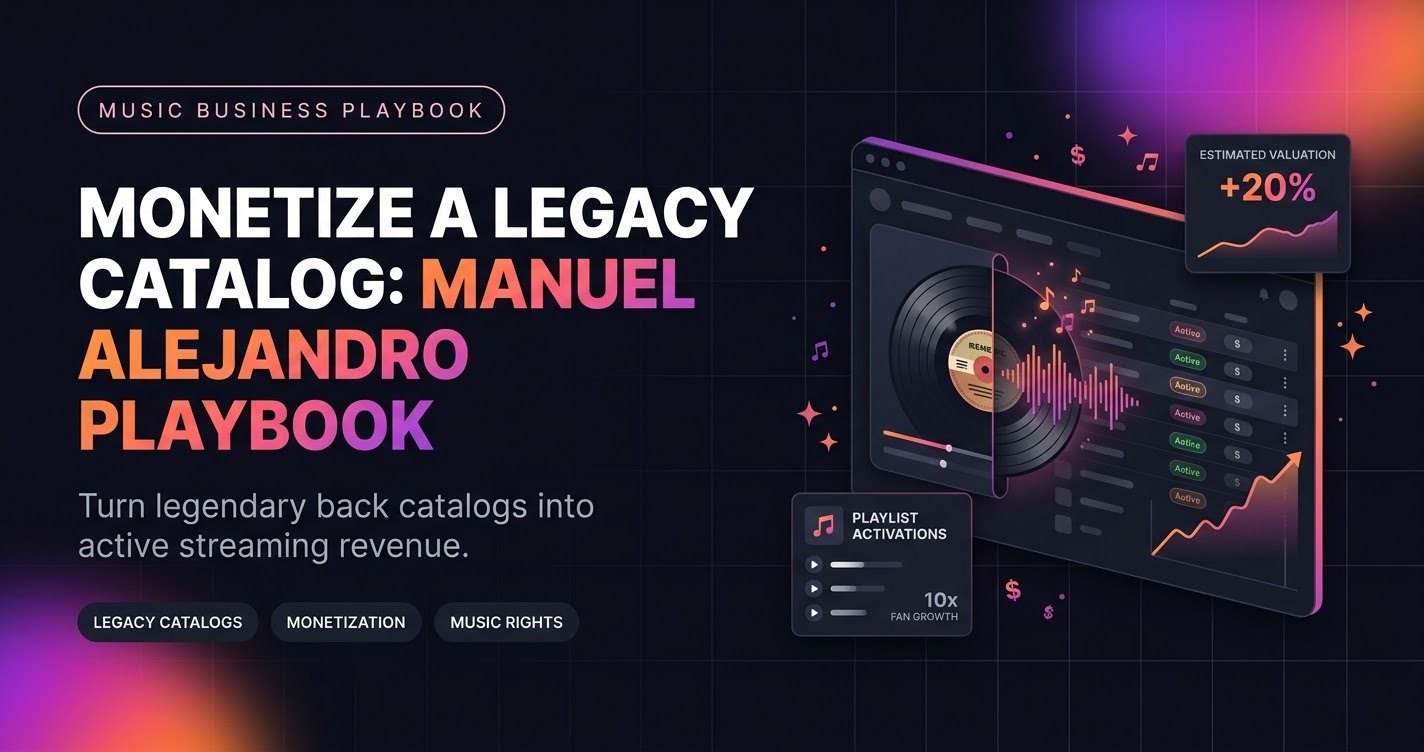
If you manage legacy material, you already know the problem: the catalog sits on the books but rarely behaves like a growth asset. The Manuel Alejandro case shows a different approach. Melboss reports a 10× Instagram audience increase and a 20% rise in annual catalog valuation after an archive-led activation that combined storytelling, a content calendar, and playlist activity. Those reported outcomes are compelling, but the public case study does not disclose baselines, revenue figures, or independent verification. Use the case as a blueprint, not proof, and combine marketing with rights readiness and strict measurement.
Why catalog activation matters now
Macro trends favor catalog plays. Luminate analysis shows catalog (music older than 18 months) accounted for more than 75% of annual audio streams in the US in 2025. Tracks from the 1980s and 1990s rose to 9.7% of on-demand streams from 6.9% in 2024. That means legacy tracks are already a majority of listening; your job is to convert latent demand into durable value through audience and rights management.
A concise pre-launch checklist
Before any playlist pitch or paid push, run a rights and metadata audit. Missed ISRCs, wrong splits, or territory blocks waste new interest and create royalty leakage. At minimum verify:
- Master and publishing ownership, splits, and advance recoupment status.
- Correct ISRCs, UPCs, and track-level metadata on the distributor.
- Accurate credits and lyrics where applicable.
- Delivery status and territory availability on DSPs.
- Registration with PROs, SoundExchange, and third-party collectors like Audiam or Songtrust if relevant.
Signal-led selection: choose tracks that will reward effort
Don’t pick songs on nostalgia alone. Use data to prioritize candidates:
- Track-level streams, saves, and playlist adds (Spotify for Artists, Chartmetric, Soundcharts).
- Geography and demographic signals showing an active audience.
- Social-video usage and UGC trends on Reels, TikTok, and YouTube Shorts.
- Search spikes and Shazam trends that indicate rediscovery potential.
For Manuel Alejandro, the catalog covers six decades and different catalog definitions exist (a 2024 interview cites more than 600 songs while Spotify for Artists lists 315). Expect similar discrepancies and resolve them during the audit.
Build a content-led reason to listen
Playlist placement amplifies attention but does not create reasons to return. Archive-led storytelling is the multiplier. Content types that convert passive listeners into repeat fans:
- Short archival clips: rehearsal, demo, or TV performance segments repurposed as 15–60 second verticals.
- Micro-documentaries or carousel posts about the songwriting process, collaborators, and hit moments.
- Contextual edits and remasters positioned as fresh listening windows.
- Anniversary bundles, collector physicals, and limited merch drops tied to campaign dates.
Melboss attributes Manuel Alejandro’s gains to archive storytelling and a content calendar. Mirror that: schedule 2–4 content drops per week for priority tracks during the activation window.
Playlisting as amplification, not a silver bullet
Pitching editorial playlists is essential, but target strategically. Your goals should be sustained listeners, saves, and repeat streams rather than vanity placement alone. Tactical steps:
- Prepare a focused pitch (one or two tracks) with a clear placement angle: mood, era, cultural moment, or a sync-ready hook.
- Target DSP editorial, independent curators, and algorithmic playlists. Use Chartmetric or Soundcharts to prioritize curators who match the song’s audience geography.
- Update artist profiles, catalog playlists, and ‘about’ sections so new listeners see context immediately.
- Monitor placement KPIs: playlist-driven new listeners, save rates, and repeat listen windows (7, 28, 90 days).
Remember: Melboss reports a 10× Instagram audience increase and a 20% catalog valuation rise, but the public study stops short of publishing streaming revenue or royalty statements. Treat playlist wins as distribution events that require downstream product offers and rights clarity to turn attention into income.
Turn attention into multiple revenue paths
Streaming royalties are necessary but not sufficient. A catalog activation should create at least three monetizable outcomes:
- Monetize sync opportunities: update cue sheets, make stems and instrumental masters available, and proactively pitch to music supervisors.
- Sell physical reissues and deluxe packages timed to campaign peaks.
- Offer direct-to-fan experiences: exclusive listening rooms, boxed sets, or ticketed anniversary shows.
Also check publishing economics: Manuel Alejandro has spoken publicly about living on advances and receiving a fraction of record proceeds, which highlights the need to verify publishing splits and recoupment before scaling promotional spend.
Measurement: separate spikes from durable lift
Measure rigorously and compare three windows: pre-campaign baseline, activation, and 8–12 weeks post-activation. Track:
- Streams, saves, and listener growth by track and territory.
- Playlist traffic sources and retention (repeat plays per listener).
- Royalties received by track and payor, sync inquiries and placements, and physical sales.
- Campaign costs: CPM and cost-per-new-follower for paid social, and ROAS on any direct sales offers.
Benchmark targets to aim for in a controlled test: a sustained 10–30% uplift in monthly streams on test tracks after 8–12 weeks, and catalog-valuation improvements in the low double digits where rights and income streams are optimized. Use Chartmetric, Spotify for Artists, Luminate and DSP reporting to validate outcomes.
Run a low-risk pilot: step-by-step
- Select 3–5 tracks with positive signals and clean rights.
- Create an 8-week content and playlist pitch calendar: 2–4 owned content drops per week, 1–2 paid boosts, and curated playlist outreach.
- Allocate a test budget: $1,000–$2,500 in paid social to amplify vertical content, split by geography aligned to listener data.
- Measure daily streams and weekly royalties, compare to the pre-campaign baseline, and flag durable lift at 8 and 12 weeks.
- Iterate: scale what produces repeat listeners and monetizes (sync, merch, reissues).
Conclusion: combine storytelling, rights, and measurement
Manuel Alejandro’s reported 10× Instagram growth and 20% catalog valuation rise illustrate what is possible when archive storytelling, content cadence, and playlist activity are applied to a legacy catalog. Use the case study as a directional blueprint: start with a rigorous rights audit, choose tracks on signals, create a content-led reason to return, treat playlisting as amplification, and measure beyond follower counts. Run a controlled pilot, protect rights and revenue splits, and optimize campaigns for durable listener retention and diversified income. If you manage a legacy catalog, plan and test now—latent value can become recurring income when activation and rights readiness move in lockstep.